/ 7 min read / English
Connecting the dots before the next model arrives
What working with my dot has helped me put into practice, and why I think the next opportunity is connecting company context, open tools and smart glasses.
By Samed Guvenc
My work has taken me from music and graphic design to hospitality, roofing and software. The tools have changed along the way. One question keeps coming back: how do I bring what I know into the thing I am working on now?
That is why dots, introduced in OpenAI's September 29 DevDay recap, have caught my attention. I have been using my dot while building this site and working through projects around my business. So far, the experience has been positive in a very practical way: an idea can become a draft, the draft can be checked, and the work can continue when I add a correction.
I watched three videos while thinking about what this shift means. My interest is in the small lessons I can apply to work I already have, and in the connections we could build next.
HUMAN / CONTEXT / CONNECTIONS
Connecting the dots.
Small lessons, put to work
I started with The AI Advantage's video about ChatGPT Dots. I wanted to bring the discussion back to my own work: what could I put into practice, and what result could I actually check? The answer would have to come from trying it on something real.
In Greg Isenberg's DevDay discussion, the 16:09 section looks at activation by customer intent and metadata. His description also points to an analytics opportunity around which agent or plugin gets selected. Earlier, around 12:36, he uses a sequence of trigger, decision, action and feedback. My takeaway is to follow the whole piece of work and look for a useful result. For this site, that means checking whether a requested change reached the live page and whether it still matched the brief.
In Nate Herk's comparison of Dots and Muse, three points stayed useful: refresh inherited context, choose integrations around the work you actually do, and check whether a task or schedule was really created. His preference for Dots in a Codex-heavy workflow was his own assessment; he also criticised parts of the interface. I take that as a reminder to test the workflow I need, rather than adopt somebody else's verdict. The relevant sections begin around 2:46, 6:00 and 11:33.
That lesson fits what happened here. I changed my mind about the logo several times. Later, I clarified that the green marks above the ü and below the ç should always be visible. The current decision mattered more than an earlier instruction about a hidden reveal. Keeping the brief current made the result easier to get right.
The part I can point to
Together, we built and published a personal site that brings my music, design, hospitality, roofing and software into one story. We worked through typography choices, corrected an iPhone header issue, and added a hero animation that moves between those different parts of my work. The blog and social profiles page now give the material somewhere useful to live.
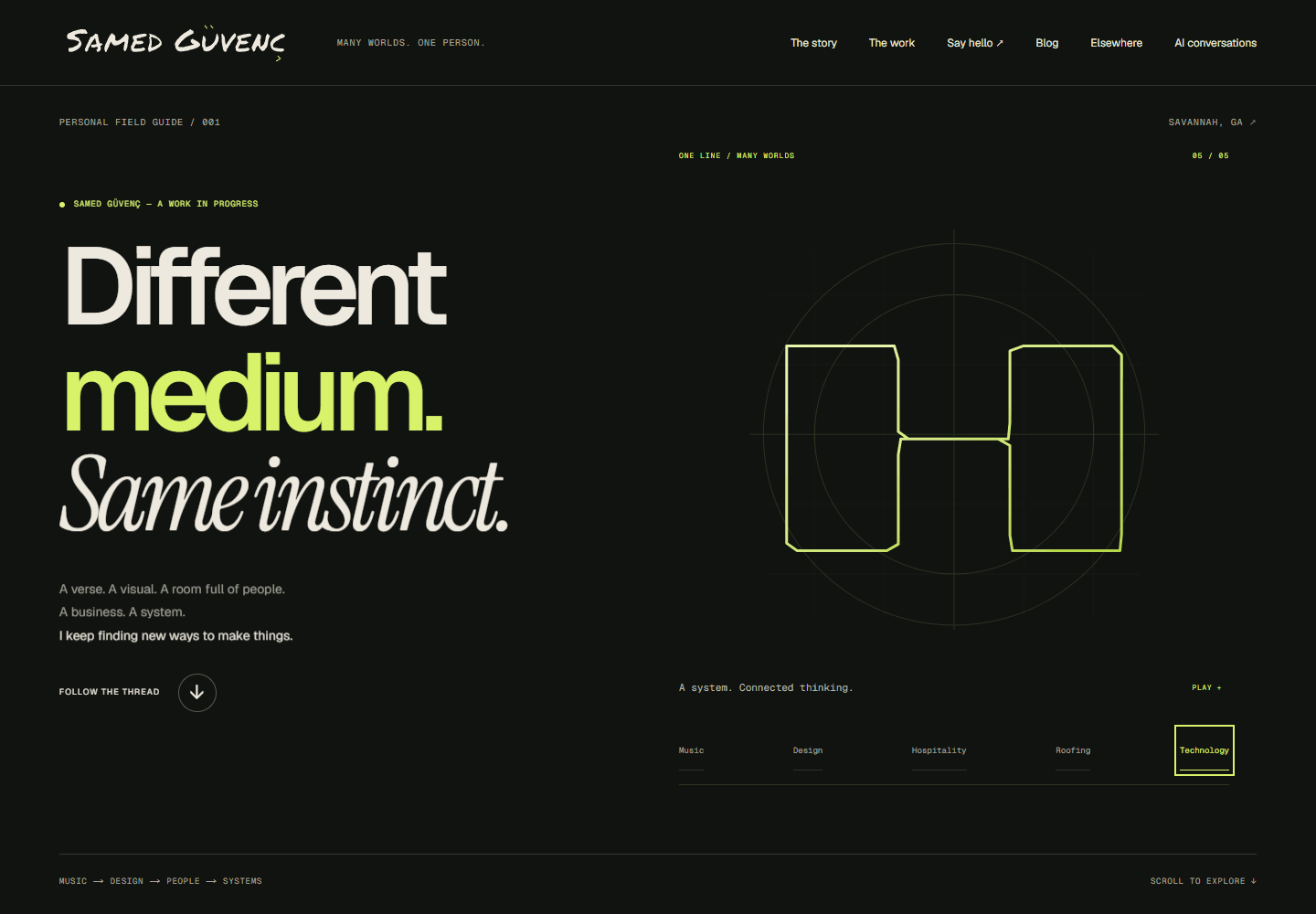
Around the business, we also worked on practical CRM details such as call and search navigation, and reviewed website claims against the available evidence. Those are ordinary details, but they affect whether someone can find the right thing and understand what a business actually does.
Another useful step was turning source notes into a journal and readable project reports. I can see what happened, what is complete and what still needs a decision. That makes the next conversation easier to continue.
A prepared voice-booking adapter remained a prototype awaiting live access. Keeping that status clear was part of the work too. A page, a test or an adapter is only one part of an operating service.
What I like about this experience is the continuity. I can bring an idea, look at a concrete result, correct it and keep going. The approvals still matter when a step changes a live system or connects an account.
Give the next model something understandable
This is the foundation I want to keep building: company context, data, processes and tools that make sense together.
For me, that starts with simple questions. Where is the source information? Which version is current? What does a field mean? Who owns the next step? Which action needs a person's approval? What evidence shows that the work is complete?
A stronger model could help with more of the reasoning. It would still need to know which information to trust and what it is allowed to do. Organising those things now gives the next model a clearer place to work. It does not guarantee that every future model or integration will fit without changes.
Dots is interesting to me because the context can travel with an ongoing responsibility. OpenAI's documentation describes relevant context across connected messaging channels and notes that memory is selective, rather than a complete record of everything said. App and computer connections are separate permissions. That matches the way I want to work: useful continuity, with clear access boundaries. Context and memory, connected channels, computers and apps.
There has been friction too. A browser I am signed into and a browser the assistant uses can have different access. Some integrations need a separate connection or approval before the next step works. That has made me more interested in building the connections carefully.
The company I would want to see
I think the next big opportunity is a company that connects existing dots, smart glasses and open-source tools around understandable company context. A persistent assistant and an interface that can be with you while you work could become a useful combination.
Smart glasses are one possible interface. I can imagine noticing something during the day, making a short request and having the right information reach the right workflow. A useful result would come back without losing the context of the work already underway. That is a product idea I want to explore; I have not connected my dot to glasses or proved that complete flow.
PROPOSED ARCHITECTURE / NOT TESTED END TO END
There are several different routes to investigate:
- Bluetooth audio for a call with my existing dot. I would need to test the real phone, glasses and call compatibility. Audio routing alone is not a custom tool integration.
- A hardware-to-tool bridge. A permitted event would need to reach the right workflow and return a useful result. Routing to the same dot, latency and permissions would need testing.
- A separate API assistant. It would need its own context, tools and permission model, rather than automatic access to my existing dot's memory.
Open-source projects could make the adapters and tool connections easier to inspect and improve. Mentra's Bluetooth SDK, for example, documents a direct iOS path to Mentra Live hardware. OpenAI documents MCP tools and event subscriptions; its event integration uses webhooks and does not support streaming. Those are possible building blocks, not a confirmed native dots-to-glasses integration. Mentra SDK, MCP tools, MCP events.
Signing in to a new app is another boundary. OpenAI's documentation says ChatGPT plan usage does not give the app access to existing ChatGPT conversations or account context. Open source also does not grant those permissions. Any integration would have to earn its access and make the data flow clear. Sign in with ChatGPT.
The opportunity, as I see it, is making these connections dependable enough to use in an ordinary day. I want to keep learning by building the foundation, testing a small piece and seeing what actually works.
What I watched
These are the three videos I started from. Their views belong to their creators; the experience and product idea above are mine. The second player starts at the 16:09 timestamp I shared.
The AI Advantage / ChatGPT Dots
Greg Isenberg / OpenAI DevDay: Dots, Agents & $100B Opportunities
Nate Herk / I Tested OpenAI's Dots vs. Meta's Muse. What You Need to Know.
Source notes
Product capabilities were checked against the official documentation on October 1, 2026. The glasses routes are proposals for future tests; the work described above keeps prototypes separate from operating services.